Blog
WYTABA: The Discipline of Purposeful Attention
What You Think About, You Bring About — a framework for aligning attention, intention, and consistent action to unlock meaningful outcomes.

What You Think About, You Bring About — a framework for aligning attention, intention, and consistent action to unlock meaningful outcomes.
Blaine Oelkers' concept of WYTABA — What You Think About, You Bring About — is frequently mischaracterized as simple positive thinking or wishful manifestation. This misunderstanding diminishes its true power and scientific foundation.
At its core, WYTABA represents a sophisticated framework built on three pillars: attention, intention, and consistency. It's not about hoping things into existence — it's about deliberately designing where your cognitive resources flow and sustaining that focus over time.
The distinction matters profoundly. Positive thinking suggests passive optimism. WYTABA demands active discipline — the conscious choice to direct mental energy toward specific outcomes, repeatedly, until systems align and opportunities become visible.
Neuroscience validates the WYTABA framework through the Reticular Activating System (RAS) — a network of neurons in your brainstem that acts as your brain's gatekeeper. Every second, millions of sensory inputs compete for your conscious awareness. The RAS determines what breaks through.
Here's the critical insight: the RAS doesn't independently decide what's important. Instead, it responds to what you've prioritized through repeated focus and emotional significance. When you establish clarity around a goal, relationship, or outcome, your RAS begins filtering reality differently.
Suddenly, you notice the book recommendation that's always been there. The colleague mentions a contact you need. The article appears at the perfect moment. These aren't accidents or cosmic interventions — they're the natural result of a properly activated filtering system recognizing patterns aligned with your priorities.
"The RAS doesn't create opportunities. It reveals the ones that were always present but previously invisible to your focused attention."

Most people experience the coincidence effect as mysterious or magical — unexpected alignments that feel too perfectly timed to be random. A chance encounter leads to a career opportunity. An overheard conversation provides the exact answer you needed. A book falls off a shelf at the precise moment you're wrestling with that topic.
These moments aren't supernatural. They're systematic.
When attention meets intention and both are reinforced consistently over time, your perceptual system realigns. The RAS heightens sensitivity to relevant patterns. Opportunities, connections, and resources that existed all along suddenly register consciously.
This is alignment — the natural outcome of a brain properly programmed to recognize what matters. Not luck. Not manifestation. Pure cognitive efficiency meeting sustained focus.
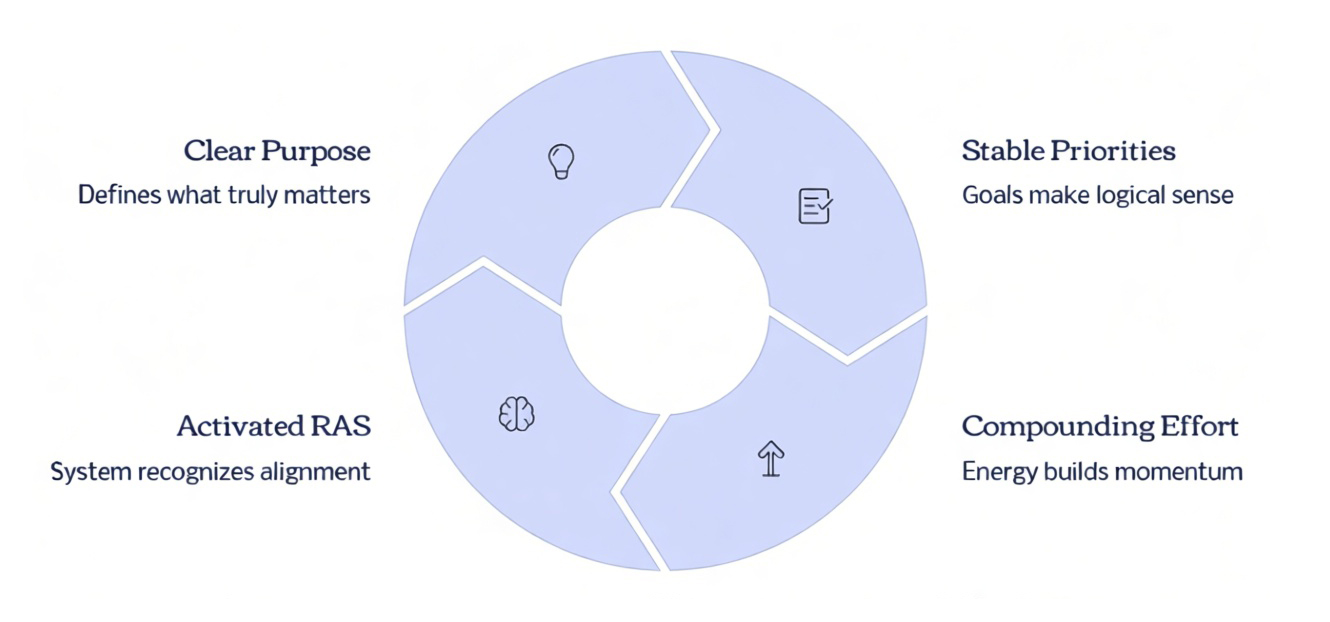
Without purpose, attention fragments across competing demands. Without clear priority, the RAS defaults to urgency rather than importance. This explains why individuals and organizations can be relentlessly busy yet fundamentally ineffective — their systems are activated, but toward misaligned targets.
Purpose acts as the primary filter. It's the foundational instruction set for your RAS. When purpose crystallizes, everything downstream clarifies. Goals make sense. Priorities stabilize. Daily decisions become easier. Effort compounds rather than cancels out.
Organizations with clear purpose experience this at scale: teams align faster, decisions gain coherence, and culture becomes intentional rather than accidental.
Blaine Oelkers' veggie patch analogy transcends metaphor — it's a precise model for how systems develop over time. Whatever you consistently plant is what inevitably grows. This applies universally: to individual habits, team dynamics, organizational culture, and leadership effectiveness.
Plant reaction, and stress becomes your harvest. Plant clarity, and capability emerges. Plant nothing intentionally, and something still grows — usually dysfunction, politics, or confusion.
The garden doesn't care about your intentions. It responds to your actions. Daily behaviors are seeds. Repeated patterns are cultivation. Culture is the crop.

Planning is never neutral. It's not a purely rational exercise conducted by a unified decision-maker. Instead, different parts show up — protective mechanisms developed through experience, each with valid concerns but often competing agendas.
These parts aren't enemies — they're protective mechanisms. But when they dominate planning processes, strategies become defensive, execution stalls, and teams lose confidence. Self-led planning creates space for these parts while ensuring they don't hijack the process. Self brings calm perspective, honest assessment, and coherent vision — qualities essential for effective strategy.

The Enneagram's Type Eight energy — when accessed from Self rather than ego — offers a critical capacity: the ability to hold paradox without collapse. It creates enough space for complexity while maintaining forward momentum.
Creating the Eight means cultivating the capacity to hold multiple truths simultaneously:
Rather than getting trapped in narrow loops — endlessly doing (the Six's action without reflection) or perpetually imagining (the Nine's vision without execution) — the Eight broadens the environment first.
It asks: Are we planting the right garden before demanding growth?
This capacity prevents the common failure pattern where organizations execute brilliantly on the wrong strategy, or develop perfect plans they never implement.
When these four elements align, something remarkable happens: culture becomes intentional rather than accidental. People know what to focus on. The organizational RAS sharpens collectively. Energy shifts from noise to measurable progress.
Global research on culture and leadership consistently validates this pattern. Clarity creates psychological safety. Safety enables performance. Consistency builds trust. Trust compounds effectiveness.
This isn't theory — it's the documented mechanism through which high-performing organizations maintain advantage over time.
WYTABA isn't about wishing things into existence. It's about designing attention with the same rigor you'd apply to any critical system. When attention aligns with intention, and both are sustained through consistent structure, transformation becomes inevitable rather than aspirational.
"When attention, intention, and structure align — plans stop stalling, goals stop drifting, and purpose becomes lived rather than stated."
What you think about, you bring about — when Self is leading and clarity is sustained.

 Creating the Eight: Emotional Intelligence, Balance, and Self-Leadership