Blog
The Space Where We Stop Fixing
On Self, Systems, and the Quiet Power of the Eight
On Self, Systems, and the Quiet Power of the Eight

For much of my life, I thought growth meant effort. More insight. More fixing. More responsibility for the emotional weather around me. I now think growth looks different. It looks like space.
Internal Family Systems (IFS) offered me a language for something I'd already sensed but couldn't quite articulate: we are not one voice, one reaction, one identity. We are systems. Parts of us rush to protect. Parts of us carry old pain quietly. Parts of us manage, organise, anticipate, soothe, defend.
And beneath all of that—not above it, not instead of it—is Self. Self isn't loud. It doesn't fix. It doesn't chase certainty or approval. Self holds.
When Self is present, something fundamental shifts. Urgency softens. Boundaries appear without force. Kindness doesn't need to be transactional. That presence has become the foundation of my work—and, increasingly, of my life.
Create the Eight didn't begin as a model. It began as a question: What is the cost of needing to be right?
I noticed how often people—myself included—get locked into positions. Sixes and nines. My truth and your truth. Fault and defence. When we stay there, energy collapses inward. Relationships tighten. Systems escalate.
The Eight emerged not as a compromise, but as a third space. Not "who's right" but "what wants to emerge if we stop defending?" The Eight is not resolution. It's regulation. It's the space that appears when Self is present long enough for systems—internal and external—to settle.

When we inhabit polarised positions, we experience a particular kind of rigidity. Energy that could flow towards curiosity, creativity, and connection instead becomes concentrated in defence and justification.
These positions feel protective—and often they are, managed by parts trying to keep us safe from vulnerability, rejection, or the uncertainty of not knowing.
The Eight offers something radically different: the possibility of co-existence without collapse or domination.
It's not about finding middle ground or forcing agreement. It's about discovering what emerges when both positions are held lightly enough that something new can arise.
This is where transformation lives—not in the positions themselves, but in the generative space between them.
One of the most surprising lessons I've learned is this: when you don't rush to fix, people often find their own footing. This applies internally—when you stop trying to silence parts—and externally, when you stop managing outcomes for others.
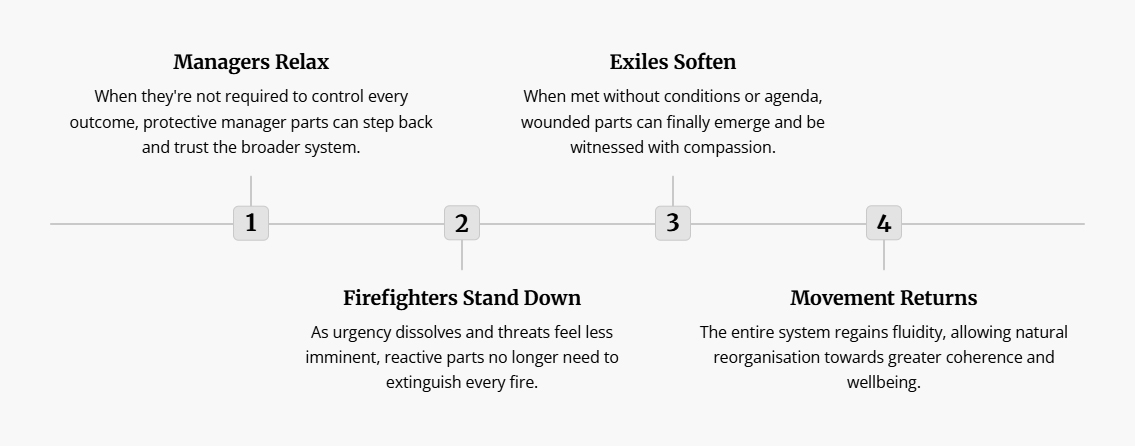

Unlock Possibilities was never meant to be a service that "fixes" people or organisations. It's closer to a tree—a structure with roots in lived experience, trunk in clarity and ethics, and branches that offer shade, not instruction.
Some people rest there briefly. Some return seasonally. Some drift away—and that's not failure. When the environment is right, growth happens naturally.
You don't force seeds to sprout. You prepare the soil. You create conditions where natural wisdom can emerge. You trust the inherent intelligence of living systems.
This organic approach honours the pace and process of genuine transformation, recognising that sustainable change cannot be rushed or imposed from outside.
Real power isn't intensity. It isn't generosity driven by obligation. It isn't being indispensable. Power is choice without attachment.
That capacity didn't come from control. It came from understanding my own system—and trusting Self to lead it with compassion, curiosity, and courage.
It's not for those who want quick answers, rigid frameworks, or certainty wrapped in authority.
It is for those who sense that something softer can be stronger. That regulation matters more than persuasion. That the most sustainable change doesn't announce itself loudly.
If any of this resonates, you're already closer than you think. You don't need to agree. You don't need to commit. You don't need to be "ready."
Notice what settles as you read these words.
Notice what parts speak up—the sceptical ones, the curious ones, the parts that feel strangely at home here.
Notice where you feel resistance and where you feel recognition.
That noticing is where the Eight begins. That's where we flow. That's where possibilities quietly unlock.
The work continues—not through force or fixing, but through presence. Through the patient trust that when we create space, when we stop defending, when we allow Self to lead, systems find their own way towards wholeness.
This is the quiet power of the Eight. This is the flow we discover together. This is where transformation lives—not in the loud proclamations or the rigid certainties, but in the generous spaciousness of not knowing, held with curiosity and care.

 The Power of Connection