Blog
The Quiet Challenge Of Understanding
A reflective exploration of what it truly means to understand another human being—and why real understanding is rarely comfortable.
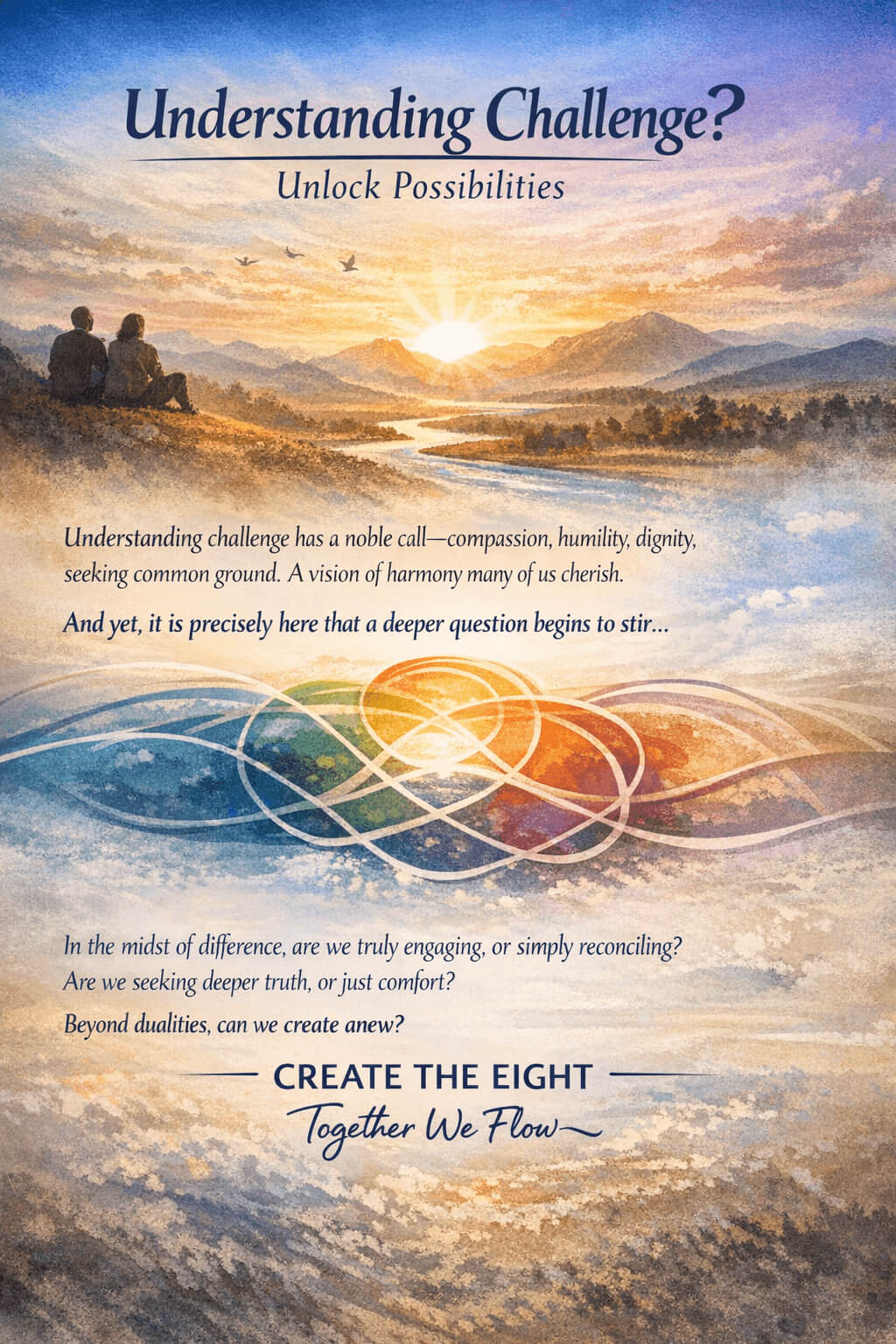
A reflective exploration of what it truly means to understand another human being—and why real understanding is rarely comfortable.

There exists a peculiar comfort we often mistake for genuine understanding. It manifests as agreement, feels like harmony, and quietly reassures us that we are good, right, or at the very least, reasonable. Yet real understanding—the kind that transforms—is rarely comfortable. It stretches our assumptions, destabilises our certainties, and asks something profoundly difficult of us.
Much of what passes for understanding today represents a softened form of tolerance: a polite nod exchanged across the chasm of difference, without the deeper, more demanding work of true encounter. We coexist in proximity, but we do not always genuinely meet. We listen, certainly, but often only long enough to translate what we hear back into the familiar language of our own worldview, our own comfortable framework.
This pattern is not a moral failure. It is, fundamentally, a human one—a protective instinct that keeps us safe, but also keeps us small.
A recent homiletic reflection invites us to consider understanding not merely as intellectual comprehension, but as an essential moral posture—one grounded in compassion, sustained patience, and a genuine willingness to perceive the full humanity in those whose beliefs, experiences, or ways of living differ markedly from our own. This reflection reminds us that judgement inevitably narrows our vision, whilst understanding expands it; that lasting peace begins not in winning arguments or proving ourselves correct, but in consciously choosing empathy over defensiveness.
At its deepest heart, this reflection gestures towards unity—not as enforced uniformity or bland sameness, but as a recognition of shared dignity that precedes and transcends disagreement. It encourages restraint over immediate reaction, genuine listening over performative certainty, and humility over the seductive comfort of moral superiority. In a world increasingly fractured by division and polarisation, this represents no small invitation. It calls us towards something higher, something more demanding.
And yet, it is precisely here, at this hopeful juncture, that a deeper, more uncomfortable question begins to stir beneath the surface.
"If every perspective is equally valid, how do we grow? How do we discern? How do we choose?"
True pluralism is not the wholesale absence of hierarchy or value judgement; rather, it represents the sophisticated capacity to contextualise hierarchy. Values exist. Priorities exist. Trade-offs exist. The crucial question is not whether these hierarchies are present—they always are—but whether we possess the awareness and honesty to acknowledge them.

Dr John Demartini reminds us that our values constantly operate beneath conscious awareness. What we confidently call "truth" is often simply the highest value around which we are currently organised.

Conflict arises not primarily because others are wrong or misguided, but because they are organised around fundamentally different value hierarchies. They navigate by a different compass.

Understanding, then, transcends mere agreement. It becomes the disciplined practice of recognising which value system is speaking—including, crucially, our own.
Psychologist Barry Schwartz, through his influential work on practical wisdom, illuminates a subtle but pervasive danger: our profound human desire for coherence can systematically override our capacity for genuine wisdom. We naturally prefer narratives that make sense to us, that fit comfortably within our existing frameworks—even when those narratives necessarily exclude inconvenient complexity or uncomfortable truths.
We receive powerful social rewards for certainty, for clarity of position, for knowing precisely where we stand on every issue. But wisdom, real wisdom, often dwells in ambiguity, in the spaces between certainties.
To truly understand another person, community, or belief system requires something counterintuitive: a temporary, deliberate loosening of our own hard-won coherence. A willingness to sit present with cognitive dissonance without rushing to resolve it, to smooth it over, to make it fit. That experience can register as threat—particularly when our very identity has become deeply entangled with our beliefs, when we cannot separate who we are from what we think.
And so, we soften the difficult edges. We preach understanding whilst unconsciously preventing the disruption that real understanding demands.

There exists a subtle, often invisible line between genuine compassion and sophisticated avoidance. Many well-intentioned messages of unity, peace, and understanding unintentionally fall into the latter category. They earnestly call for harmony without transformation, for peace without the necessary friction, for understanding without acknowledging its true cost.
Yet every meaningful human advance—whether relational, cultural, or spiritual—has required friction. Not violence, not domination, not the crushing of dissent. But honest, generative tension. The kind that changes us.

At Unlock Possibilities, we speak of Create the Eight—the movement beyond simple polarity and binary thinking. Not this or that. Not right versus wrong. Not choosing between false opposites.
But rather, the disciplined, demanding work of holding apparent contradictions in creative tension.
The symbol of the eight represents not balance as static stillness, but balance as dynamic flow—a continuous, living exchange between perspectives, values, and lived realities. Understanding, in this more sophisticated sense, is not passive reception. It is profoundly creative, generative, transformative.
Understanding, when practised with full integrity, requires us to ask difficult questions—questions that may not have comfortable answers, questions that may unsettle our carefully constructed sense of self.
"Real understanding is not passive. It is creative. It requires us to remain present even when every instinct urges us to withdraw into the safety of certainty."
This reflection does not call for the abandonment of belief, faith, or deeply held conviction. It does not suggest that all perspectives are equivalent or that discernment is unnecessary. Rather, it extends a more nuanced invitation: to examine honestly whether our particular version of understanding genuinely expands life—or whether it primarily serves to keep us comfortable, safe, and unchallenged.
Real understanding is rarely tidy. It does not resolve everything neatly. It frequently leaves us changed in ways we could not have anticipated or controlled. And perhaps that transformation, that willingness to be altered by encounter, represents its quiet, profound purpose.
Not to make us right, vindicated, or morally superior.
But to make us more fully, authentically, courageously real.
"The question is not whether we will understand perfectly. The question is whether we possess the courage to keep trying."

 The Space Where We Stop Fixing