Blog
The Power of Connection
Why thriving begins before strategy

Why thriving begins before strategy

For decades we've asked the wrong question. Not How do we live longer? Not How do we perform better? Not even How do we heal?
The more useful question seems to be: What kind of environments allow people to stay whole?
The answer, quietly and consistently, points in the same direction. It's not found in individual optimisation or personal discipline alone. It emerges from something far more fundamental — the quality of connection that surrounds us, holds us, and allows us to contribute meaningfully throughout our lives.
The world's so-called Blue Zones — places where people live longer, healthier lives — are often reduced to habits: what they eat, how much they move, how little they stress. But that framing misses the deeper pattern.
What these communities protect — sometimes fiercely — is connection. Not constant connection. Not forced connection. But embedded connection.
No one is optimising themselves in isolation. Belonging isn't an outcome in these places — it's the starting condition.

Marie McLeod's Beacon model names something many feel but struggle to articulate: thriving doesn't begin with confidence, capability, or clarity. It begins with belonging.
Before people can take risks, they need safety. Before they can innovate, they need acceptance. Before they can lead, they need to feel held by something larger than themselves.
A beacon doesn't pull people towards it by force. It stands steady enough that others orient naturally.
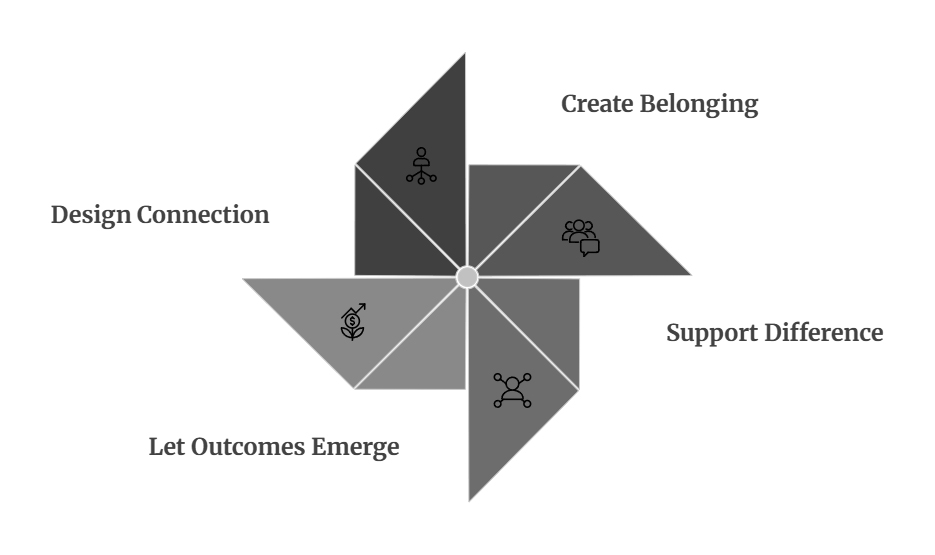
Connection is often treated as a feeling. In reality, it's a design choice.
Blue Zone communities don't rely on good intentions alone. They build structures that reduce friction, creating environments where connection happens naturally rather than requiring constant effort.
Connection isn't left to chance. It's architected.
What's striking is that none of these systems insist on a single way of being. There is room for difference, disagreement, multiple truths, and changing roles across seasons of life.
This is a pluralistic orientation — not everyone being the same, but everyone being included. When systems allow multiple perspectives to coexist, something stabilising happens.
People stop defending. They start listening. And paradoxically, alignment increases not through enforcement, but through genuine acknowledgement of diverse experiences and viewpoints.
Much of modern stress comes from binary thinking: right or wrong, success or failure, strong or weak. The communities that thrive longest don't eliminate tension. They hold it differently.
This is where Create the Eight quietly lives: not in choosing sides, but in creating enough connection that sides matter less. When belonging is secure, people can hold complexity without fragmenting.

Unlock Possibilities exists at this intersection: where belonging meets agency, where systems support people rather than extract from them, where difference is not something to manage, but something to design for.
The work is not about fixing people. It's about building conditions where people can bring more of themselves without fear.
We support leaders, designers, and community-builders in creating environments that honour wholeness from the start — recognising that thriving emerges not from individual excellence alone, but from the quality of connection that surrounds and sustains us.
If thriving feels elusive, it may not be a personal failing. It may be a signal — a signal that connection has been treated as optional, belonging as a reward, and difference as a threat.
The Blue Zones suggest something simpler and harder: Design for connection first. Everything else follows. Not immediately. Not linearly. But reliably.
What if the question isn't how to optimise ourselves, but how to design environments that allow us to stay whole?
What if belonging isn't something we earn, but something we build into the very fabric of how we gather, work, and live?
What if thriving begins not with strategy, but with the simple, profound act of being seen, expected, and useful to one another?
The communities that endure longest don't eliminate complexity. They create enough connection to hold it.

 From Protecting Harm to Unlocking Possibility