Blog
Sometimes a Scorpion Is Just a Scorpion
Discernment, reaction, and creating the eight—an Unlock Possibilities perspective on trust, awareness, and leadership.

Discernment, reaction, and creating the eight—an Unlock Possibilities perspective on trust, awareness, and leadership.
The story of the frog and the scorpion is timeless. The scorpion asks the frog to carry it across a river. The frog hesitates, acutely aware of the scorpion's dangerous nature. The scorpion promises it will not sting—after all, doing so would ensure they both perish in the water below.
Midway across the river, with the shore still distant, the scorpion strikes. When the frog asks why, gasping as they both begin to sink, the answer is disarmingly simple: "It's my nature."
This story is traditionally told as a warning about trust and betrayal. At Unlock Possibilities, we see it as something far more valuable—a profound lesson in discernment.
"It's my nature."
What if the frog was not naïve? What if the frog knew exactly what it was dealing with—and still attempted to engage safely? This reframing transforms the entire narrative.
Through consistent observation across individuals, teams, and organisations spanning diverse industries and cultures, one pattern emerges with remarkable consistency: outcomes improve significantly when awareness precedes action.
Mental fitness is not blind optimism or wishful thinking. It represents the disciplined ability to pause instead of rushing headlong into decisions, to notice patterns rather than justify them away, and to hold multiple truths simultaneously without collapsing into fear or hope.
In the frog-and-scorpion story, mental fitness is precisely what allows the frog to recognise genuine risk without demonising it—and to choose thoughtfully how, or indeed whether, to cross the river at all.
In psychology, this tendency to misread behaviour is exceptionally well documented. The Fundamental Attribution Error, a term coined by renowned psychologist Lee Ross in 1977, describes our deeply ingrained habit of over-attributing others' behaviour to character whilst substantially under-weighting context, pressure, or circumstance.
This cognitive bias distorts our judgment in both directions, creating systematic blind spots in how we interpret human behaviour.
The frog-and-scorpion story appears, at first glance, to reinforce attribution: the scorpion stings because it is a scorpion. But the deeper lesson proves far more nuanced and valuable.
The frog's error is not attribution itself—it is ignoring repeated evidence in favour of hope. The scorpion does not sting because of the moment; it stings because pressure reveals a consistent, predictable pattern. Discernment is not about blaming character prematurely. It is about recognising when behaviour stops being situational and starts being predictable.
Brené Brown's influential BRAVING framework gives crucial structure to this discernment, transforming abstract concepts into observable, actionable elements. Trust is not all-or-nothing—it exists on a spectrum, and each element can be dialled up or down based on what is observed over time.

Ian Berry, in his influential works Changing What's Normal and Heart Leadership, speaks eloquently about holding strong opinions lightly. This concept proves critical in navigating the tension between discernment and rigidity.
Holding opinions lightly does not mean ignoring evidence or abandoning conviction. Rather, it means remaining open without being exposed, staying curious without being careless, and adjusting course without self-betrayal.
The frog's challenge was not awareness—the frog clearly understood the risk. The challenge was assuming awareness alone would somehow override nature, that knowledge could substitute for appropriate boundaries.
From an Internal Family Systems (IFS) perspective, developed by Dr. Richard Schwartz, pressure reveals parts—those distinct aspects of our personality that emerge under stress or threat. This lens offers profound insight into both our behaviour and others'.
The scorpion's sting is not random or malicious. It is a part taking over—often after clear warning signs such as boundary resistance, disproportionate reactions, or narrative shifts when accountability appears. These are not moral judgements. They are signals.
Mental fitness allows us to observe these signals without becoming reactive ourselves—and to choose thoughtfully how we engage next, if at all.
One of the most consistent learnings in leadership, coaching, and organisational development work is this fundamental truth: Reaction is data. Not intent. Not explanation. Not promise. Reaction.
How someone responds when boundaries are introduced, when pressure increases, or when accountability is required often tells us considerably more about future behaviour than any stated value, mission statement, or verbal commitment ever could.
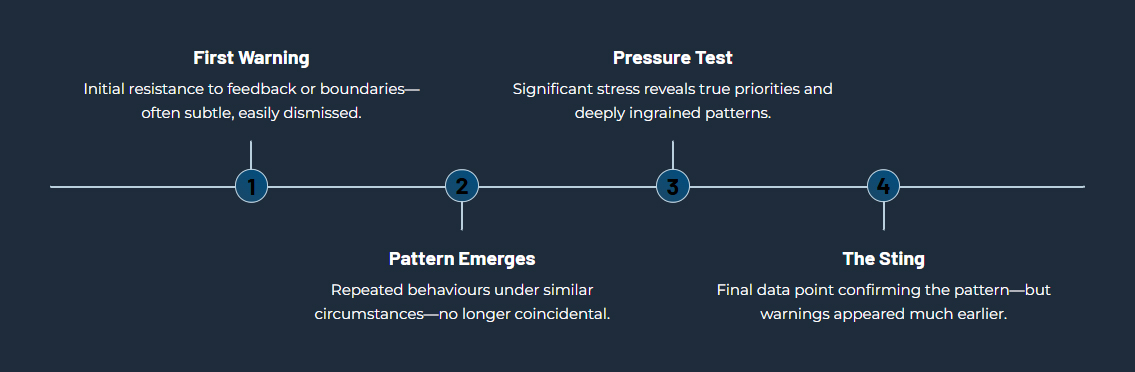
In the frog-and-scorpion story, the sting represents the final data point in a series—but crucially, the warning often appears much earlier in the journey. The question becomes: are we paying attention?

At Unlock Possibilities, we speak about Create the Eight—the essential capacity to respond to complexity with balance, nuance, and wisdom. Some behaviours are genuinely situational, context-dependent responses to temporary pressure. Some behaviours are fundamental, deeply rooted patterns that will persist across contexts.
Sometimes a six becomes a nine when viewed from a different perspective. Sometimes it was always a nine, and the perspective shift reveals truth rather than creating it.
Even when significant challenges arise, we retain agency in how we respond. Creating the eight means maintaining this balance point—neither naive optimism nor cynical withdrawal, but clear-eyed discernment.
This lesson matters most in the workplace, where the consequences of poor discernment compound over time, affecting teams, culture, and organisational health. When taking on a new employee, client, or supplier, discernment must be central—not secondary or afterthought.
Sometimes the scorpion is the right partner for a particular journey. Sometimes it is not. And sometimes knowing the difference protects not just yourself, but the entire system you're responsible for leading.

 From Seeing Both Sides to Creating the Eight